By Aimé Keay
Act for Peace’s Aimée Keay reports from the refugee camps in Jordan which has long been a safe haven for millions of people displaced by conflict in the Middle East. Jordan hosts one of the world’s largest refugee populations relative to its size, including more than 2.3 million Palestinian refugees. Hundreds of thousands of Syrians also remain in Jordan where return is still uncertain or unsafe. And thousands more from Iraq have also sought refuge and asylum in Jordan.
I recently travelled to Jordan to spend some time with Act for Peace’s local partner, Department of Service to Palestinian Refugees (DSPR) and met with community members who are part of the Forsa (which means ‘opportunity’ in Arabic) program. During my visit, I had the privilege of hearing from Palestinian and Syrian refugees and local Jordanian families.
Awatif
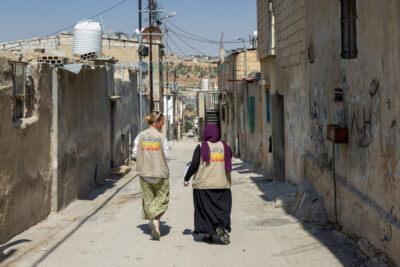
“Peace means that we live with lasting freedom,” said Awatif. For Awatif, the dream of freedom is shaped by a history of displacement. She’s lived her whole life in refugee camps – first in tents, then mud huts and now a block-built house.
“My family suffered a lot through the experience of [seeking] refuge. They moved from place to place, almost walking all the way from Gaza to Jordan when they were displaced,” she said.
Some of those I met had completed the two-year Forsa program and shared how it had helped them build new skills, livelihoods and connections. Others were just beginning, speaking with hope and determination about the possibilities ahead and the future they want to build for themselves and their families.
Forsa is a holistic program that supports Syrian and Palestinian refugee families build sustainable livelihoods and greater self-reliance through skills development, confidence and ongoing mentoring. The program also engages Jordanian host community families who are facing significant financial hardship, strengthening relationships and social cohesion across communities.
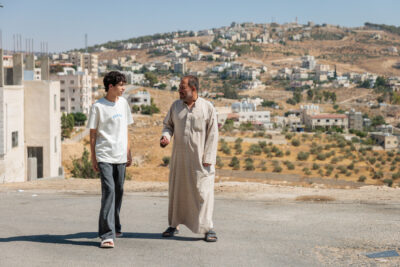
Dalal and Abdullah
When I met Dalal and Abdullah, they shared some of the emotional and social impact of displacement. While they had found safety in Jordan, leaving their family and home behind in Syria came at a high cost.
“It’s so hard that I left my country and came here to the camp and stayed for three months, and I left my family there… I left my home and my family, my brothers, my sisters, my mother and my father,” says Dalal.
Abdullah’s still feels a deep sense of loss at leaving his family behind.
“We came here with something broken inside us.”
But as the family prepares to embark on a new journey in the Forsa program, they are filled with hope at what their future might hold.
“I want to stand on my own feet and support each other,” says Dalal. “I’d like to go out of the home, meet new people, feel better mentally, connect and talk with others.”
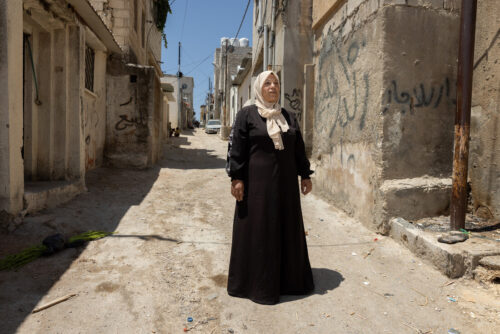
Nidal
I also met Nidal, a mother of five who is of Palestinian heritage but was born in Syria and then sought refuge in Jordan with her family.
“A refugee…above all, carries an aching longing for their homeland,” she explains.
“As Palestinians, there are many challenges we face, especially living in refugee camps,” says Nidal. “Unemployment, and our children can’t work easily without work permits and those who want to get permits lack funds to pay for them.
“What changed things was after joining the Forsa program, attending the sessions, my mental state gradually improved, I realised: I have a skill, I can work, and I can pull myself up from the bottom and rebuild my life.”
To witness the incredible transformation Nidal shared, filled me with a sense of deep hope for Abdullah and Dalal as they start out on their journey, knowing the change that is possible.
As Nidal so openly shared, the sense of belonging and connection in her community runs deep and inspires great hope.
“The refugees here—even in the worst circumstances—you find them standing hand in hand. No matter what problems or rivalries they have, you find them standing together sincerely, whether in sorrow or joy. They are always together.”
Act for Peace gratefully acknowledges the support of the Australian Government through the Australian NGO Cooperation Program (ANCP).
A more detailed version of Aimée’s report is available.