The NCCA gathers together Churches and Christian communities which confess the Lord Jesus Christ as God and Saviour according to the Scriptures. We commit to deepen our relationship with each other and to work together towards the fulfilment of common witness, proclamation and service, to the glory of the one God, Father, Son and Holy Spirit.
World Council of Churches Calls for Transformative Action on Global Polycrisis
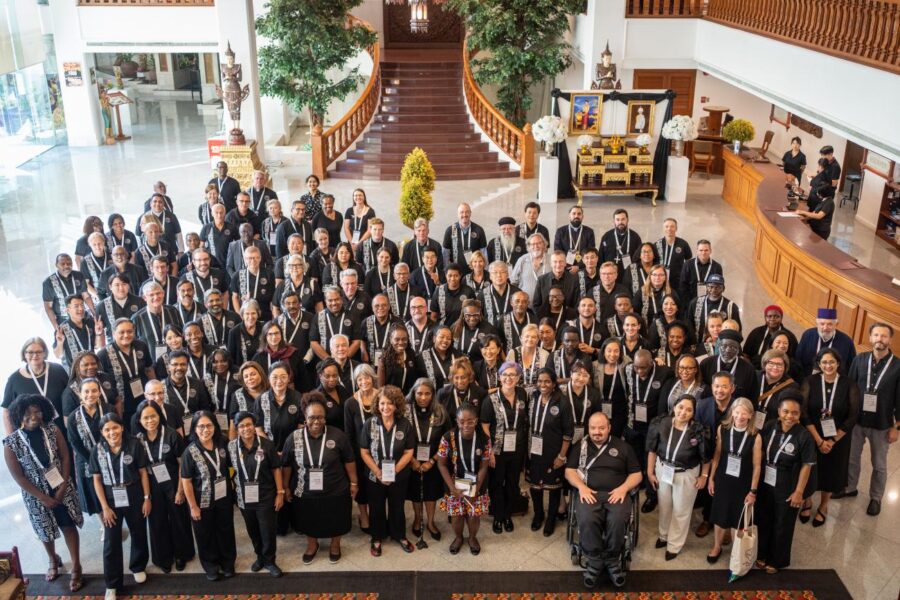
Photo: Sean Hawkey/WCC
Church leaders and ecumenical representatives from around the world have called for urgent, transformative action to address interconnected global crises, including climate change, armed conflict, inequality, racism and emerging technologies, following a major international meeting in Chiang Mai, Thailand.
Held from 4–9 October 2026, the biennial joint meeting of the World Council of Churches (WCC) Commissions and Reference Groups on Life, Justice and Peace was hosted by the Christian Conference of Asia and the Church of Christ in Thailand. Participants gathered to consider how churches and their partners can respond to growing threats to humanity, communities and the natural world.
The meeting described the current period as a defining moment for humanity and creation, marked by escalating wars, democratic decline, environmental destruction, displacement and widening economic inequality. Participants also expressed concern about shrinking civic space, declining investment in public health and social services, and increasing military expenditure.
They warned that vulnerable communities, particularly women, children, Indigenous Peoples and those already experiencing poverty and discrimination, bear a disproportionate share of these burdens.
Lessons from history
Drawing on more than a century of ecumenical social thought, participants identified disturbing parallels between today’s global situation and the political tensions of the 1930s.
At the 1937 Oxford Conference on Church, State and Society, churches grappled with economic hardship, threats to democracy, racial hatred, military aggression and the breakdown of international cooperation. While the ecumenical movement sought greater Christian unity and a deeper theological understanding of the relationship between citizens and the state, some churches supported totalitarianism and Christian nationalism.
The meeting warned that these dangers have returned in contemporary forms, reinforcing the need for churches to resist the misuse of religion to justify exclusion, discrimination and political domination.
Participants recalled the challenge posed by German theologian Dietrich Bonhoeffer in 1935, when he questioned whether the church could speak the demands of Jesus Christ to a world heading towards war. They asked whether churches today have the courage to confront injustice and violence, rather than remain silent or complicit.
Participants also challenged Christian nationalism and the misuse of religion to justify exclusion, racial discrimination and political domination. They argued that Christian unity must be demonstrated through solidarity with others, rather than confined by national, cultural or religious boundaries.
Climate justice and responsible technology
Climate change is an urgent moral and ethical challenge. The meeting criticised the inadequate response to environmental destruction and called for stronger climate action, responsible financing and legal measures to hold financial institutions accountable for environmental harm.
Indigenous knowledge and community leadership were identified as essential to a just environmental future. Participants stressed that Indigenous Peoples must have meaningful decision-making power over matters affecting their lands, oceans and livelihoods, rather than simply being consulted.
Artificial intelligence (AI) was another major concern. While recognising its potential benefits in medicine and scientific research, participants warned of risks involving surveillance, autonomous weapons, sexual and gender-based violence, exploitative working conditions and environmental damage. They called for stronger regulation and greater public accountability to ensure technology serves human wellbeing.
Turning commitments into action
The meeting urged churches to move beyond declarations towards practical change. It proposed five questions for decision-making: Who sets the agenda? Who controls resources? Whose knowledge counts? Who bears the risks? And who is accountable to whom?
Participants reaffirmed the ecumenical vision of “Just Peace”, encompassing peace within communities, in economic life, with the Earth and among peoples. They also called for more equitable participation, stronger partnerships, support for displaced and marginalised communities, and renewed advocacy for accessible healthcare and fairer international economic systems.
Despite the gravity of the challenges, the gathering concluded with a message of hope. Through repentance, solidarity, shared responsibility and courageous action, churches are called to demonstrate that Christian unity means standing with those who suffer and working towards a more just, peaceful and sustainable world.