
 The reason for reaching out to Christians of other faith traditions and seeking the unity of all believers in our Lord Jesus Christ may seem obvious; after all, the Lord Himself prayed “that they may all be one; even as You, Father, are in Me, and I in You, that they also may be in Us, so that the world may believe that You have sent Me” (John 17:21).
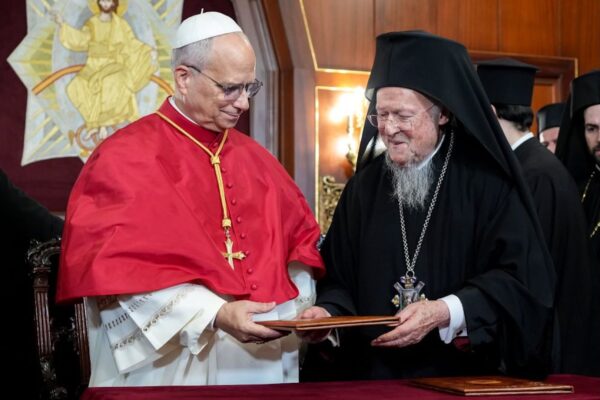
Yet it can further be asked: How can such unity be achieved? And why is it important that the believers “all be one”? What would result from such unity? On May 9, 2026, Ecumenical Patriarch Bartholomew elucidated these issues and more at a Mass celebrated at the Roman Catholic Church of the Holy Spirit in Constantinople, commemorating the first anniversary of the election of Pope Leo XIV of Rome.
His All-Holiness noted the progress that had been made toward unity during the past year, including during Pope Leo’s historic visit to the Phanar (the historic residence of the Patriarch in Istanbul): “Looking back over this past year, we can only give thanks to God for the deepening rapprochement that continues to inspire our two Sister Churches of Rome and Constantinople.”
The Ecumenical Patriarch emphasized that this progress toward unity was not an option or a luxury, but was, in fact, “irreversible” …
“… the Creed of Nicaea remains a living bond of communion, calling both Churches to rediscover one another in the truth they already share.” As such, Nicaea “is not only a memory, but a horizon: a point of spiritual orientation from which the path toward the restoration of full communion can be discerned anew.” It demonstrates that “reconciliation is not an abstract ideal, but a living vocation entrusted to the Churches, so that their unity may become a credible witness to the truth and love revealed in Christ.”
Turning then to the question of what ecclesiastical unity would accomplish, the Ecumenical Patriarch quoted from his common declaration with Pope Leo: “Allow us to repeat what we declared together: ‘The goal of Christian unity includes the objective of contributing in a fundamental and life-giving manner to peace among all peoples. Together we fervently raise our voices in invoking God’s gift of peace upon our world. Tragically, in many regions of our world, conflict and violence continue to destroy the lives of so many. We appeal to those who have civil and political responsibilities to do everything possible to ensure that the tragedy of war ceases immediately, and we ask all people of good will to support our entreaty.’”
Accordingly, “the pursuit of Christian unity is therefore not inward-looking, but profoundly outward-facing: it is a mission for the life of the world. It is a concrete and necessary contribution to reconciliation among peoples, to the healing of divisions, and to the cessation of violence. In a time when war and conflict continue to wound the human family, this shared appeal resounds as both a moral and spiritual summons—to leaders, to communities, and to all people of goodwill—to labor tirelessly so that the tragedy of war may cease.”
Read the Patriarch’s reflection.
Source: Archons.org