

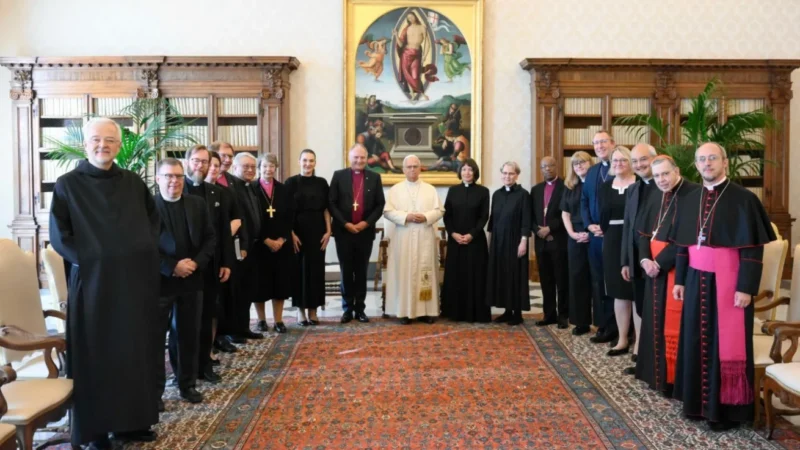
Leaders of the Lutheran World Federation (LWF) met with Pope Leo XIV in the Vatican, looking forward to the ways in which Lutherans and Catholics can commemorate together the 500th anniversary of the Augsburg Confession in 2030.
Henrik Stubkjær, LWF president and bishop of Viborg in the Church of Denmark, led the delegation of Geneva Communion Office staff and LWF vice presidents representing member churches around the world. He gave thanks for the Roman Catholic leader’s repeated calls for “disarmament, the rejection of weapons and the need for dialogue,” as well as concerns outlined in his encyclical letter Magnifica Humanitas about the future of Artificial Intelligence.
“The LWF understands itself as a movement within the one ecumenical movement for the sake of the one church catholic,” Stubkjær said. He recalled the joint commemoration of the Reformation “exactly 10 years ago this month,” as Lutheran leaders came together with Leo’s predecessor, Pope Francis, in the Swedish cities of Lund and Malmö. “The ecclesial journey from conflict to communion between Catholics and Lutherans has borne significant fruit, not least in the Joint Declaration on the Doctrine of Justification, which continues to inspire wider ecumenical cooperation,” he said.
Reflecting on ways in which Lutherans and Catholics continue to deepen that dialogue today, Stubkjær spoke of the joint International Lutheran-Catholic Commission on Unity, which began 60 years ago and is now in its sixth phase, working on a joint statement to mark the 500th anniversary of the Augsburg Confession. That document, he said, “is part of that theological lineage stemming from St Augustine. In 1530, it was an ecumenical proposal to the church that highlighted the apostolic roots of the reforms and the desire for the church’s unity. It was never meant to divide but sought a dialogue for mutual discernment of gospel proclamation in its day.”
Although the proposal did not succeed in the 16th century and separation ensued, Stubkjær said, “today, however, we can start telling a different story” by lifting up the ecumenical dynamic in the current context. “It is our hope that Catholics and Lutherans will be able to commemorate this anniversary together on June 25, 2030, in Augsburg, where the Confession was first presented.”
Pope Leo also shared his hopes for the ecumenical potential of the Augsburg anniversary. “Renewed communion in the apostolic faith, in the sacraments and in the ministries, is the goal of our ecumenical journey of grace, which we walk together guided by the gospel,” he said. “On our journey from conflict to communion, he noted, “there are special moments. The year 2030 … can become one such shared moment: a profound ecumenical experience that can give new energy and joy to the steps we will take towards full visible unity.”
Source: lutheranworld.org