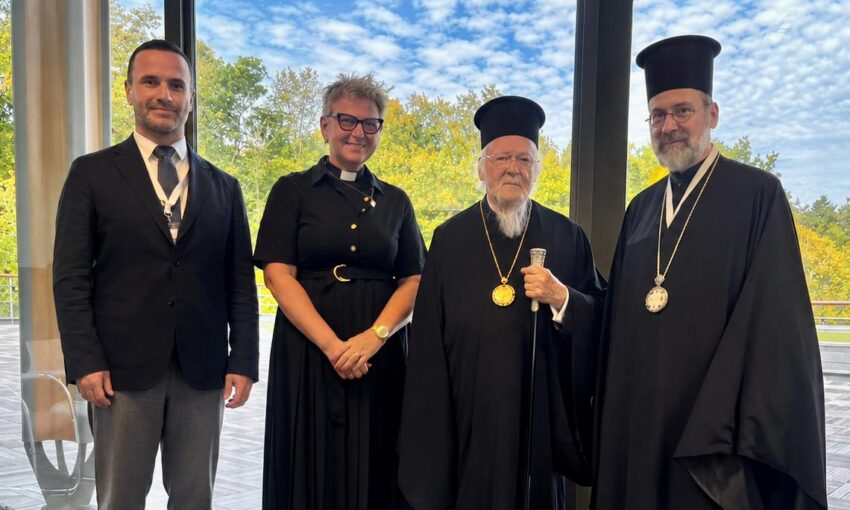
“I am deeply impressed by the continuing commitment to ecumenism and to the visible unity of the church expressed by the Ecumenical Patriarch and by the Orthodox churches represented at this gathering”, said Rev. Prof. Dr Stephanie Dietrich, moderator of the World Council of Churches (WCC) Commission on Faith and Order.
Dr Andrej Jeftić, director of the WCC Commission on Faith and Order, reflected that the Holy and Great Council of the Orthodox Church reaffirmed and gave conciliar recognition to the Orthodox commitment to the ecumenical movement. “As such, it represents a significant milestone not only in the life of the Orthodox church, but also in the history of the ecumenical movement itself,” he said. “Its explicit recognition of the World Council of Churches, and particularly of the theological work undertaken by the Commission on Faith and Order, underlines the importance of our common efforts towards Christian unity.”
“As we continue our common work towards Christian unity, we also continue to wrestle with the question posed by the Sixth World Conference on Faith and Order: ‘Where now for visible unity?’ The reflections on the Holy and Great Council, its legacy and reception, form an important part of this ongoing process of theological discernment and our shared journey towards the visible unity of the church,” said Jeftić.
From the Great Council’s document on Relations of the Orthodox Church with the Rest of the Christian World:
The Orthodox Church, as the One, Holy, Catholic, and Apostolic Church, in her profound ecclesiastical self-consciousness, believes unflinchingly that she occupies a central place in the matter of the promotion of Christian unity in the world today.
The Orthodox Church, which prays unceasingly “for the union of all,” has always cultivated dialogue with those estranged from her, those both far and near. In particular, she has played a leading role in the contemporary search for ways and means to restore the unity of those who believe in Christ, and she has participated in the Ecumenical Movement from its outset, and has contributed to its formation and further development.
In this spirit, all the local Most Holy Orthodox Churches participate actively today in the official theological dialogues, and the majority of these Churches also participate in various national, regional and international inter-Christian organizations …