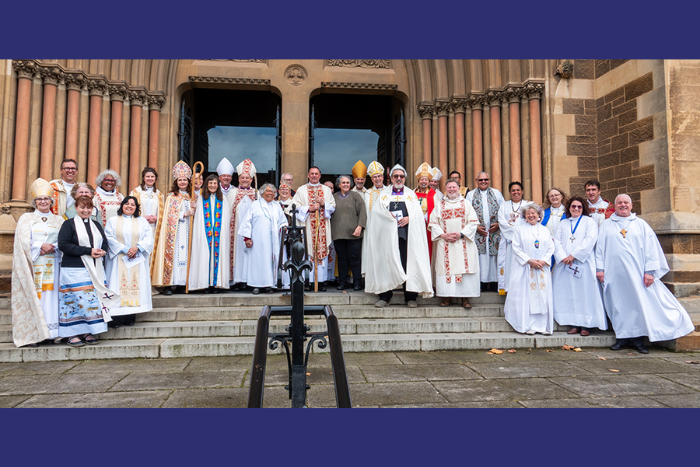
The Anglican Indigenous Network (AIN) of the worldwide Anglican Communion with delegates representing Indigenous communities in Aotearoa, the United States, Hawai‘i, Canada, Australia and the Torres Strait Islands; has met in person at St Peter’s Cathedral, Adelaide and elected a new Chair of the network, Canadian Indigenous Archbishop Most Revd Chris Harper.
The meeting from September 4 to 7 served to further the existing dialogues around how the worldwide Church can support Indigenous Peoples and how First Nations People can also contribute to the life of the Church with their unique gifts and knowledge.
The AIN was founded in 1992 to help give voice in the Anglican Church to Indigenous Peoples who are minorities in their ancestral lands. The network exists to affirm the shared spirituality, concerns, gifts and hopes of Indigenous Anglicans, alongside a commitment to bring Indigenous leadership and vision more fully into the life of the Church.
Challenges and opportunities facing First Nations People in the Anglican Church
Despite the diversity of countries, cultures and ecclesial structures represented around the table, Indigenous Anglican leaders identified similarities in the challenges confronting their communities.
Australia – two new Indigenous Bishops
In recent months, significant developments for Indigenous Anglicans in Australia have given renewed importance to the gathering. The Anglican Church of Australia’s General Synod made the decision this year to fund full-time National Aboriginal and National Torres Strait Islander Bishops. These two roles will serve as Assistant Bishops to the Primate. The decision is a milestone in the history of the Church’s witness of commitment to collaboration and reparation between the Anglican Church and First Nations People.
Aotearoa / New Zealand – first Maori Woman Bishop
The Rt Revd Susan Wallace, Bishop of Te Waipounamu in Te Pīhopatanga o Te Waipounamu, the first Māori woman bishop in the Anglican Church, shared perspectives on the evolution of Te Pīhopatanga o Aotearoa (the Māori Anglican Church). She reflected on the journey of Tikanga Māori (Māori customs and processes), from the constitutional promise of Te Pouhere (the 1992 commitment by the Anglican Church in Aotearoa, New Zealand and Polynesia to operate as an equal partnership of three distinct cultural streams) and the vision of Te Oranga Ake (human flourishing), through to the assent to Bill 15 at General Synod, which placed the administration of funds from St John’s College Trust Board with the Māori Church.
Levi Torrey, a Dean-in-training in Te Hui Amorangi ki Te Upoko o Te Ika, spoke about the flourishing youth ministry within his Hui Amorangi (episcopal unit), while also highlighting the challenge of sustaining and expanding that work as its sole youth worker.
Canada
The Most Revd Chris Harper, National Indigenous Anglican Archbishop of Canada, spoke about a season of renewal and the work of Sacred Circle, a national gathering of Indigenous Anglicans for prayer, worship, discernment and decision-making. He highlighted the Sacred Circle Covenant, presented to General Synod in 2023, which articulates the relationship between Sacred Circle, Indigenous ministries and the wider Anglican Church of Canada.
Archbishop Chris Harper also reflected on The Covenant and Our Way of Life, a document expressing who Indigenous Anglicans are and how they understand their place within the Church, including their right to shape ecclesial life according to their own contexts, cultures and languages. He also acknowledged the continuing tensions Indigenous Anglicans encounter within inherited colonial and liturgical structures.
Underlying these conversations was a common aspiration to move Indigenous Anglican communities beyond survival towards flourishing, while offering their gifts to the wider Anglican Communion.
Despite the challenges many report in terms of resources, shortages of Indigenous clergy and ministry workers and insufficient representation within Church decision-making, time was also spent emphasising the distinctive gifts Indigenous peoples bring to the Church through relationships with land and water, storytelling, song, spirituality and community. These considerations were understood not simply as cultural contributions, but as sources of theological insight capable of enriching the life and mission of the wider province.
Uncle Ray Minniecon of Scarred Tree Ministries in Sydney closed the meeting with a reflection on Psalm 116:12, the same verse posed by the Revd Richard Johnson in the first Christian sermon to Australian settlers: ‘What shall I render unto the Lord for all his benefits toward me?’
Uncle Ray suggested that, for Indigenous peoples, perhaps the response might now be found in the verses that follow: ‘I will take the cup of salvation and call upon the name of the Lord.’
Adapted from Anglican Communion News Service