

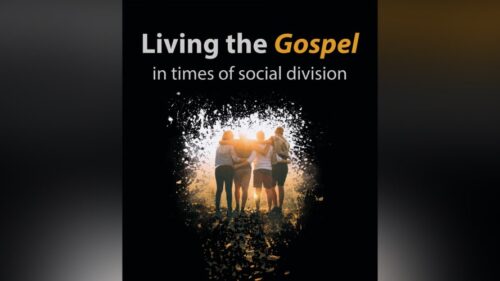
 The latest Catholic social justice statement, Living the Gospel in Times of Social Division has been released.
“This statement invites us to see our current social climate as an opportunity to witness to the Gospel,” writes Conference President Archbishop Timothy Costelloe SDB in the preface to the statement.
“We offer Jesus and the hope borne of his death and resurrection. When we choose forgiveness over enmity, hospitality over isolation and solidarity over vilification, we help to create the conditions in which a more peaceful society can prosper.”
The statement explores recent developments in Australia including the Bondi Beach attack of December 2025 as well as the alarming rise in Islamophobia and other forms of racism.
It also lists a range of actions to build social cohesion, which it argues can only come through practising a “culture of encounter”.
“Love draws us out of ourselves and into a culture of encounter with others,” the statement says.
“It entails drawing close to others who have very different life experiences from ours. It means deep solidarity with them, seeing their plight with our hearts and not just with our eyes, listening intently and not just hearing, not passing by, but stopping to engage with them with great compassion, not pity.”
Source: Cathnews
The statement and related resources can be found at Social Justice Statements
Anglican Primate urges hope to address concerns about social cohesion
The Right Reverend Dr Mark Short, Bishop of Canberra and Goulburn and Anglican Primate of Australia, raised social cohesion in his president’s address to the General Synod of the Anglican Church of Australia. He said:
“At the social level our sense of community and cohesion has come under increasing pressure.
“… at the level of online rhetoric and public debate there is a tendency to see those who differ from us in some regard as a potential threat rather than a potential partner; increasingly we find it easier to ascribe motives and intentions to others on the basis of their religious, political and cultural identities rather than as a result of patient conversation.
“Beyond and beneath, there are more fundamental questions being asked at national or existential level. What does it mean to be Australian? What are the ‘tacit assumptions and latent frameworks of meaning’ that bind us together notwithstanding our disagreements? Are we a multicultural or monocultural nation and if the latter who gets to decide what constitutes that culture?
He offers Christian hope located in the faithfulness of God as a way forward:
“What are the defining features of Christian hope? First, it is personal. In 1 Peter 1:3 believers are assured that the God and Father of our Lord Jesus Christ “has given us a new birth into a living hope through the resurrection of Jesus Christ from the dead.” Christian hope is also communal. In passages such as 1 Thessalonians 1:2-3 the fledgling church is commended for “your work of faith and labour of love and steadfastness of hope in our Lord Jesus Christ.” Hope is something they manifest together. Finally, and ultimately Christian hope is cosmic. It looks forward not just to the salvation of individuals or the redemption of a people but to the liberation of creation itself when Christ returns (Romans 8:21).
“Engaging our nation in hope will then mean giving attention to the action of God within its life, not to justify the nation but as an action of witness to the faithfulness of God despite our failings corporate and individual. It will mean recovering the Pauline emphasis on the gospel of the Lord Jesus Christ as a dynamic power at work in our world. When St Paul writes to the Colossian Church “You have heard of this hope before in the word of the truth, the gospel that has come to you. Just as it is bearing fruit and growing in the whole world, so it has been bearing fruit among yourselves from the beginning” he disavows any notion that the gospel is merely an inert message which he delivered to them like a sales pitch.
“Most of all, we might and should give thanks that the work of God across these three strands (of culture – Indigenous, Anglo-Celtic and Multicultural) has never been in competition but always complementary, because we worship a God of abundance whose grace is never a zero-sum game. Hence the folly of enshrining one culture or expression of culture as normative, since culture is as dynamic as the God who is constantly at work in through and above it for His glory.”