
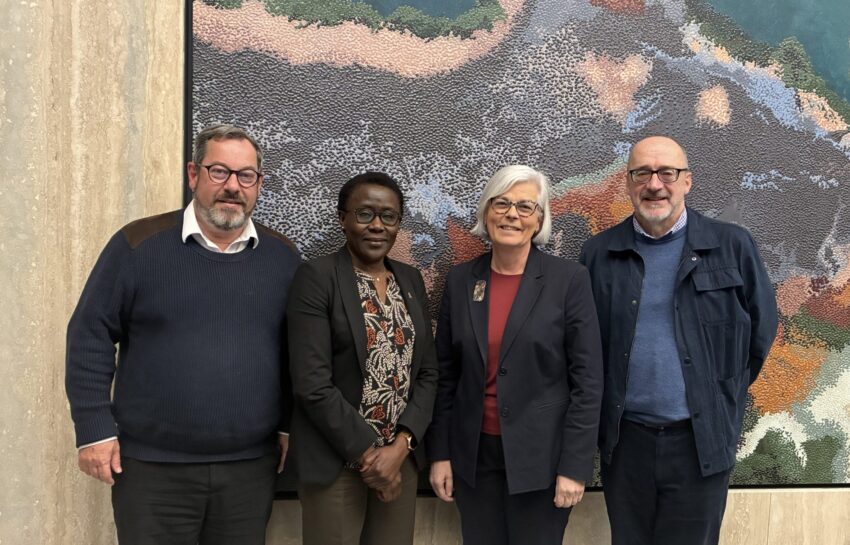
Rev. Prof. Dr Kuzipa Nalwamba, World Council of Churches (WCC) programme director for Unity, Mission, and Ecumenical Formation, visited the NCCA office prior to giving the May McLeod lecture at the United Theological College in Australia on 30 July.
The lecture, titled: “From Memory to Healing: Engaging Justice, Reconciliation, and Unity in a Wounded World,” offered a theological framework for engaging the interrelated challenges of memory, justice, reconciliation, and unity in a world marked by collective trauma, structural violence, and ecclesial division.
Drawing on biblical concepts of anamnesis, mishpat, diakonia, katallagē, and koinonia, the presentation argued that healing requires more than the passage of time or superficial gestures of peace.
The lecture was significantly informed by the work of the Joint Working Group between the WCC and Roman Catholic Church, particularly the current work of one its task groups titled “Collective Reconciliation: Processes and Tools in Global Contexts” (2025–2030).
“This ecumenical framework is collating practical tools that churches have applied to navigating historical wounds and divided societies,” she said.
“The desert traditions of early monasticism—particularly from Wadi El Natrun, which was the venue for the Sixth World Conference on Faith and Order—also serve as recurring theological motifs for spiritual struggle against systemic and historical sin.”
She also introduced her audience to May McLeod, and explained why the lecture, since 1989, was established in memory of McLeod. “As a laywoman and stalwart of the Uniting Church in Australia, her active ministry focused on pastoral care and championing church inclusion,” said Nalwamba. “She embodied what it means to build bridges and address social fractures.”
In her lecture, Nalwamba acknowledged that we live in a world deeply marked by collective trauma, structural violence, and ecclesial division.
“We are called to a more excellent way: the difficult, sacred journey from memory, through justice, to reconciliation, and into unity,” she said. “This is not a linear path but a spiral—a deep and often painful engagement with the past to open a new future.”