
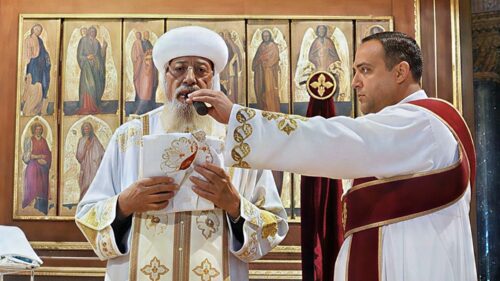
The image is jarring: a man dragged through the streets of Alexandria, his flesh torn away on the rocks, the ground stained red. This is how the Coptic Church remembers the death of its founder. Not with soft iconography. With violence, and with pride. When Pope Tawadros II celebrated the Divine Liturgy at St Mark’s Basilica in Venice on May 9, 2026, that founding wound was quietly present in every chant.
More than ceremony
To outside observers, the event might have read as a gracious gesture — Rome offering its famous basilica for a visiting patriarch’s service. It was considerably more than that.
The Coptic Church does not celebrate its liturgy lightly. It will not pray in unconsecrated spaces. That Pope Tawadros chose to celebrate at St John Lateran in 2023 and now, at St Mark’s in Venice is a deliberate theological statement: these places, consecrated by the Roman Church, are recognised as genuinely sacred. The courtesy runs in both directions.
Twenty centuries, two hours
What made the Venice liturgy strange and luminous in equal measure was its compression of time. The first Alexandrian patriarch — St Mark the Evangelist, missionary, martyr — and the 118th stood in the same room, separated only by the membrane of prayer and memory.
The Coptic Church does not treat sacred space casually. That Pope Tawadros celebrated liturgy at a Catholic basilica — not once, but twice in three years — signals a quiet theological recognition that cuts deeper than diplomatic courtesy or interchurch goodwill.
Read the article by Kyrillos ElMacari, a Coptic Orthodox monk.
Source: flashesinsight.com