

The Future of Synodality: How we move forward from here by Kristin M. Colberg and Jos Moons, SJ. (Collegeville, Minnesota, USA: Liturgical Press, 2025, Kindle edition). $42.90, 214 pages.
A book review by John Littleton, February 2026.
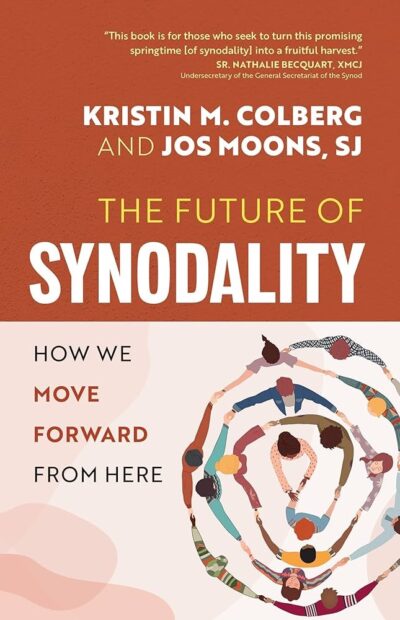 Theological College Librarians should buy The Future of Synodality, a wise and practical guidebook on synodality for Christian communities, the world-wide Roman Catholic Church in particular. It is a SMART book: specific, measurable, achievable, relevant and time lined. The co-authors write out of their experience of synodality in Rome, under the leadership of Pope Francis during the years 2021 to 2024, where the synodal methodology of walking together was tried and tested. Synod, syn hodos, means to be together on the way.
The authors, Colberg and Moons outline the theological and historical foundations as well as the processes of synodality in Part I, describing six snapshots of synodality. Then, in Part II, they consider ways towards synodalizing the attitudes, behaviours, structures and practices of the Church into the future, in the local, regional and world-wide contexts.
Specifically, synodality is a way of proceeding through the guidance of Christ in the Spirit, so that all the People of God community of the faithful journey and learn together on the way. (Pages 17-19) It is a method for dialogue involving the whole church in a lived experience and expression of the Christian life listening to the Spirit.
The processes outlined are measurable. The spiritual conversations are conducted in seven steps: individual preparation, gathering in small table groups, sharing and listening, a silent pause (2-3 minutes), sharing and listening, another silent pause, identifying key points. (72-79) These seven stages of the learning process seek to heighten awareness of and sensitivity to the Holy Spirit, rest on the belief in the dignity and co-responsibility of all the baptised and recognise that ‘everyone’s voice deserves an equal chance to be heard and to be assured of a welcoming, engaged and respectful reception’. (73)
These seven steps are achievable. Clear guidelines are provided. Outcomes were achieved. Five themes emerged from the listening in the spiritual conversations: ‘more formation, greater inclusion, an embrace of synodal structures and practices, better liturgies, and new roles for women’. (117)
Part II of the book is full of relevant practical suggestions. In answering the question asked on page 121 ‘What does it take to Synodalize the Church?’ the authors present relevant and exampled changes to church practices: habits and customs, attitudes, behaviours and structures. A synodal church is a new way of proceeding, and includes a new openness, active listening, common discernment by everyone, laity and clergy, not only bishops and the pope. (133) Chapter Six is called ‘From Talking the Talk to Walking the Talk’. Chapter Eight provides examples of the synodal pathway. The section on the Benedictines is relevant, ‘Learning from their wisdom in how to walk the synodal path’. (177-193) Benedictine spiritual, pastoral and multifaceted leadership is discussed. ‘With its model of ministry rooted in community and service, the Benedictine tradition can help us synodalize ecclesial practices, offering a helpful alternative to exclusively hierarchical ways of proceeding’. (188)
Appendix I provides ‘A Timeline of Key Events of the Synod 2021-2024’. Appendix II provides ‘A Timeline of key Documents in Relation to the Synod 2021-2024’. The ‘Select Bibliography’ is an extensive and rich resource of Official Church Documents, Papal Addresses, Letters and Homilies, including Academic and Pastoral resources. (199-214) Chapter Endnotes enlighten. The timeline for the Roman Catholic synod on synodality was Diocesan, Continental, Universal.
I write this Book Review as a retired Anglican priest/minister, one who has learning community approach to Christian learning in parishes. Members from many parishes meet together annually in a Diocesan Synod. The Anglican tradition has worked in a synodal way for over one hundred years using a parliamentary model process in synods. Parish Council members minister in partnership with the parish priest.
UK Anglican priest theologian, Paul Avis, editor of the Journal of Ecclesiology wrote an editorial in 2023 entitled ‘Synodality and Anglicanism’. I agree with Avis when he concluded in his article that the Anglican tradition across the worldwide Anglican Communion lives a synodal life in the local, national and international arenas. I also agree with him that ‘Nevertheless, the churches of the Anglican Communion have further to travel to realize the ideals of inclusiveness, participation, discipleship and shared responsibility’. * The Future of Synodality topic applies to the Anglican tradition today. For example, use of the Conference provision alongside a parliamentary model in the Adelaide Diocesan Synod is one way to enter further into the synodal way of being church. The Spiritual Conversation process as presented in this guidebook helps sensitivity to the Holy Spirit to grow.
Theological Colleges across the spectrum of Christian Traditions should make this guidebook available in the library. The synodality expression of Church community is an ecumenical adventure as well as a Roman Catholic journey to further the cause of Jesus Christ together on the Way.
* Paul Avis, ‘Synodality and Anglicanism’, Ecclesiology (21 June 2023, online), p. 4. Further reading. Susan K. Wood, A Synodal Church: The Christian Faithful on Pilgrimage (London, Dublin, New York: Rowan & Littlefield Publishing, 2025).